
BUYING GUIDE
Best Dehumidifiers UK (2026): 5 Practical Picks
Quick answer: For most heated UK homes, a quiet 10–12L compressor dehumidifier is the best starting point. Choose 20L for larger rooms, heavier condensation or frequent indoor laundry, and consider a desiccant model for colder unheated spaces. If excess humidity is contributing to mould, see our Best Dehumidifiers for Mould Prevention UK guide.
Not sure which size you need? Open Dehumidifier Size Calculator →
We compared current UK models across moisture removal, noise, running power, tank handling, and energy efficiency. For estimates based on your tariff, use our Dehumidifier Running Cost Calculator. If running cost matters most, see our Best Low-Energy Dehumidifiers UK guide. We also compared laundry use, including whether a dehumidifier or tumble dryer makes more sense for drying clothes, and suitability for different room types. For cold, damp rooms, see our Dehumidifier vs Heater guide. If bathroom steam and condensation are the main problem, see our Best Dehumidifiers for Bathrooms UK guide. These picks are based on published manufacturer specifications and current pricing, not hands-on lab testing.
Listed prices were last checked 29 September 2026 and are historical reference prices, not live quotes. Verify the retailer price and availability before purchasing.
QUICK PICKS
Best Dehumidifiers UK 2026: Quick Picks
BEST OVERALL

MeacoDry Arete One 12L
A balanced choice for flats and homes up to around three bedrooms, with 35–38 dB noise, a 2.5L tank, laundry mode and a 5-year warranty.
BEST VALUE

Pro Breeze OmniDry 12L
A lower-cost 12L compressor model with sub-36 dB operation, 2L tank and laundry mode for medium rooms.
BEST FOR LAUNDRY / LARGE ROOMS
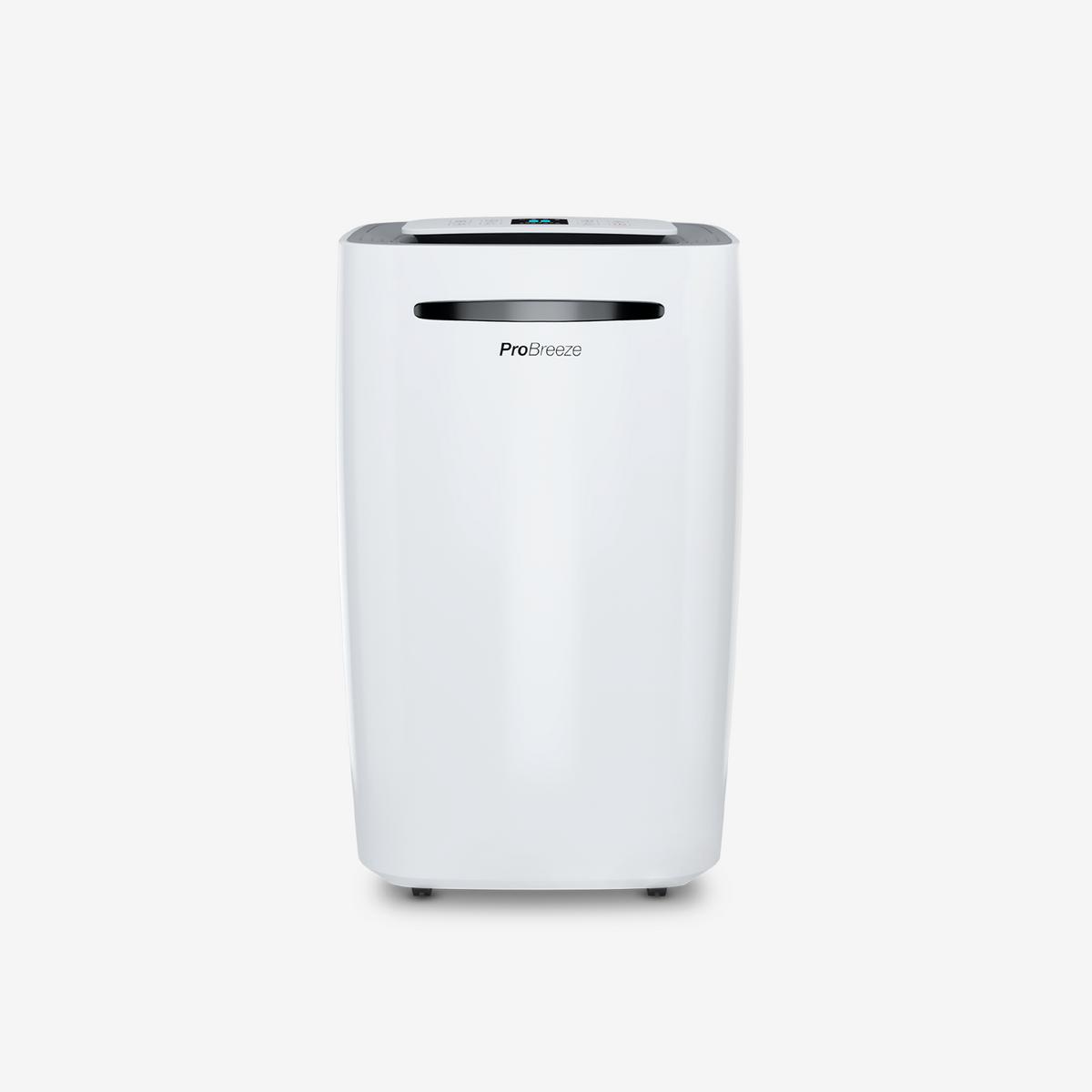
Pro Breeze 20L Max Extraction
20L rated extraction, 195 m³/h airflow, 5.5L tank and dedicated laundry mode at a competitive price.
BEST PREMIUM LARGE-HOME OPTION

MeacoDry Arete Two 20L
A more premium 20L model with app control, three fan speeds, air purification, smart laundry mode and a 5-year warranty.
BEST FOR COLDER SPACES

EcoAir DD1 Simple MK3
A 7.5L desiccant model designed to keep working from 1°C, making it more suitable for colder garages, basements and unheated rooms.
HOW WE CHOSE
What We Compared
We prioritised verified manufacturer data: extraction rate, typical power draw, noise, water-tank size, drainage options, operating temperature, laundry functions and warranty. We also considered current UK pricing and whether the feature set makes sense for the intended room or use case. Rated litres per day are measured under specified laboratory temperature and humidity conditions, so real extraction in a typical UK room can be much lower. For example, Meaco lists 5.23L/day at 20°C and 60% RH for its 12L Arete One, against its 12L headline class. Compare running power at the same test conditions where possible, rather than assuming a higher extraction rating means a lower electricity bill. We do not claim personal testing where none has taken place.
DETAILED PICKS
The 5 Dehumidifiers We Would Shortlist
1 · BEST OVERALL
MeacoDry Arete One 12L
Historical reference price (29 September 2026):£179.99 · Compressor · 35/38 dB · 151W at 20°C/60% RH · 2.5L tank · Laundry mode · Continuous drainage · 5-year warranty.
Why it stands out: the Arete One 12L combines low noise, sensible power consumption and easy everyday features without moving into premium pricing. Meaco positions it for flats and apartments, single rooms and smaller homes, and the model includes HEPA filtration as an extra benefit.
Pros: very quiet for a compressor model; low published power draw; laundry mode; front tank; HEPA filter included; long warranty.
Trade-offs: no app control or on/off timer on the Arete One; the tank has no carry handle; current direct availability can vary.
Check price at Meaco UK2 · BEST VALUE
Pro Breeze OmniDry 12L
Price at last check: £124.99 · Compressor · 36 dB (published) · manufacturer lists 0.18 kWh energy consumption (period unspecified) · 2L tank · Up to 20 m² · Laundry mode · Continuous drainage.
Why it stands out: it targets the same general 12L home-use category at a lower price. Its published 36 dB noise figure is competitive on paper. However, the stated 0.18 kWh energy-consumption figure does not specify a clear measurement period or test conditions, so it should not be treated as directly comparable with Meaco’s 151W figure measured at 20°C and 60% RH. For a direct head-to-head, see our Meaco Arete One 12L vs Pro Breeze OmniDry 12L comparison. If you are choosing between Meaco generations, see our Meaco Arete One vs Arete Two comparison. It is a sensible shortlist option for bedrooms, small flats and medium rooms when budget matters. If your budget ceiling is strict, see our Best Dehumidifiers Under £150 UK guide. If price versus extra features is your main decision, see our Budget vs Premium Dehumidifier comparison.
Pros: competitive price; quiet operation; compact footprint; laundry function; automatic humidity control; continuous drainage.
Trade-offs: smaller tank than some rivals; published room coverage is more modest; warranty terms are less prominent than Meaco’s 5-year cover.
Check Pro Breeze price3 · BEST FOR LAUNDRY / LARGE ROOMS
Pro Breeze 20L Max Extraction
Historical reference price (29 September 2026):£149.99 · Compressor · 38 dB · 310W · 5.5L tank · Up to 30 m² · 195 m³/h airflow · Laundry mode.
Why it stands out: the 5.5L tank and 195 m³/h airflow are practical for heavier moisture loads and indoor laundry. For users who need more capacity than a 10–12L model without spending close to £300, it offers strong specifications for the money.
Pros: large tank; strong airflow; dedicated laundry mode; 20L rated extraction; sleep mode; continuous drainage.
Trade-offs: higher power use than 12L models; physically larger and heavier; no app control on this version.
Check Pro Breeze price4 · BEST PREMIUM LARGE-HOME OPTION
MeacoDry Arete Two 20L
Historical reference price (29 September 2026):£299.99 · Compressor · 38/40/50 dB · 207W at 20°C/60% RH · App control · Smart laundry mode · 5-year warranty.
Why it stands out: this is the feature-rich option for larger homes. It adds app control, a louvre, three fan speeds, smart laundry mode and air purification while keeping published power use relatively low for its class.
Pros: strong feature set; app control; high airflow; smart laundry mode; HEPA air purification; long warranty.
Trade-offs: much higher upfront price; high fan speed is noticeably louder; overkill for a single small room.
Check price at Meaco UK5 · BEST FOR COLDER SPACES
EcoAir DD1 Simple MK3
EcoAir listed price checked 29 October 2026: £199.98 (subject to change) · Desiccant · 34/47 dB · 300W low / 580W high · 2L tank · 1–35°C operating range · 3-year warranty.
Why it stands out: unlike compressor models, a desiccant unit remains useful in low temperatures. EcoAir specifies operation from 1°C and positions this model for colder rooms, basements, cellars and similar spaces.
Pros: works in cold spaces; light at 6 kg; laundry mode; directional louvre; continuous drainage; simple controls.
Trade-offs: substantially higher power consumption than compressor models; smaller tank; turbo mode is louder.
Check EcoAir priceWhich Size Should You Choose?
For a heated bedroom, flat or modest damp problem, a 10–12L compressor model is usually the most sensible starting point. If you are unsure whether you need the extra capacity, compare our 12L vs 20L Dehumidifier guide. For larger spaces, heavy condensation or frequent indoor laundry, 20L models offer more headroom. For garages, basements or other colder rooms, a desiccant model can be more suitable because compressor performance falls as temperatures drop.
FAQ
Common Questions
Is a 12L dehumidifier enough for a UK flat?
Often, yes. A 10–12L compressor unit is commonly aimed at flats, bedrooms and smaller homes. The right choice still depends on room size, humidity level, temperature and how much indoor laundry you dry.
Is a 20L model always better than a 12L model?
No. A 20L model usually has more capacity but is larger and can use more power. For a single bedroom or small flat, a good 12L model may be the more practical choice.
Compressor or desiccant?
Compressor models are generally the better fit for normal heated living spaces. Desiccant models make more sense in colder or unheated rooms because they are less dependent on warm ambient temperatures.
Affiliate & Research Disclosure
Airmestra may earn a commission from qualifying purchases made through affiliate links, at no extra cost to you. As an Amazon Associate I earn from qualifying purchases. Product specifications and prices can change. This guide is based on published manufacturer information rather than hands-on testing.